 Plausible, but still rumor-y: Chinese paper Economic Daily News says new iMacs are coming next month, which goes with what we've been hearing about about Nvidia chipsets and new Intel quad-cores.
Showing posts with label nvidia. Show all posts
Showing posts with label nvidia. Show all posts
Wednesday, December 24, 2008
Rumor: New iMacs Shipping Next Month
Plausible, but still rumor-y: Chinese paper Economic Daily News says new iMacs are coming next month, which goes with what we've been hearing about about Nvidia chipsets and new Intel quad-cores.


Monday, December 22, 2008
Intel increases share in Imagination, counters Apple move
 The world's largest chip maker has increased its share in graphics chipset design company Imagination to 3.04%. The announcement comes just 48 hours after it was confirmed that Apple has acquired a 3.6% stake in Imagination to secure graphics chip blueprints for use in future iPhones. Although the timing of Intel's move may attract some attention, industry watchers note that Intel, just like Apple, is a licensee of Imagination's future PowerVR graphics and video IP cores, which means that SoC vendors can combine Intel's Atom processor with a PowerVR graphics cores on a single die.
 According to Apple Insider, Intel acquired an additional 933,422 shares in Imagination through its investment company Intel Capital. The transaction increases Intel's share in Imagination to 3.04%.
Apple is believed to be a licensee of Imagination's fourth-generation PowerVR MBX Lite 3D accelerator that is used in the current generation iPhone and iPod
While the recent developments around Imagination may hint to a new rivalry between Apple and Intel, it has to be noted that Intel is a licensee of Imagination's future graphics and video cores IP as well. This does not necessarily mean that Intel will build an Atom SoC with PowerVR SGX/VXD graphics and video cores. Instead, the chip maker may simply want to allow others to incorporate the Atom processor and PowerVR graphics into their own SoC designs. Although Atom is predominantly used in cheap, sub-10” notebooks called netbooks, some vendors are expected to push the product category envelope in terms of graphics performance and power efficiency beyond of what Atom may be capable of delivering.
These vendors include Apple whose rumored $600 Mac netbook may run the company's own SoC built around an ARM processor design and PowerVR or possibly Nvidia graphics. Nvidia also plans to move into the netbook and MID market with its upcoming SoC called Tegra, expected early next year. It will incorporate an ARM-based CPU and an Nvidia GPU core on a single die, in addition to the northbridge, southbridge and primary memory functionality. First Tegra-powered products are expected early next year, which could include a Zune phone with Tegra chipset.
VIA's announced Trinity platform features a three-chip solution that packs VIA's latest Nano x86-64 processor, VX800 IGP chipset and discrete S3 "Chrome" graphics on an 800 MHz FSB single package, providing DirectX 10.1, HD video, Blu-ray/h.264/MP4 hardware acceleration and HDMI output on less than 70 watts max (50 watts typical).
Pressure from Nvidia, Apple and more than 500 companies that build SoCs around ARM processor blueprint is giving Intel a serious run for its money. Its next-generation Atom processor, code-named Moorestown, will not be ready until 2010. In addition, the chip maker seems to have underestimated a number of vendors planning to build products around VIA and ARM processor designs. While Intel claims Moorestown will consume up to ten times less power than the current-generation Atom and will feature SoC design with main processing and graphic cores on a single die, including a memory controller and video encoding and decoding cores, the company will have to fill the gap throughout 2009 - until Moorestown arrives.
Nvidia bids to dislodge Intel as rivalry gets ugly

Intel and Nvidia are entering into a new, nasty phase of competition. What's at stake? Only the future of the personal computer.
Though the Santa Clara, Calif., neighbors (only a couple of miles from each other) have never really been on speaking terms, the rivalry is intensifying with the emergence of the Netbook--small, lightweight laptops priced below $500.
The competitive backdrop is still the same--Intel's longstanding (and very successful) vision of a CPU-centric universe versus Nvidia's creed that graphics processing matters more and more in a multimedia-intensive world.
The challenge for Nvidia is that as laptops downsize into Netbooks, a graphics vacuum has been created. And Nvidia abhors a graphics vacuum.
Thursday, December 18, 2008
NVIDIA GeForce GTX 295 Video Card Specifications Announced
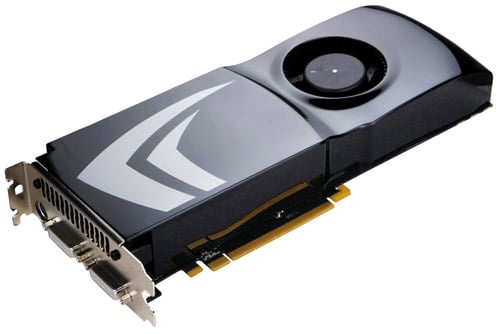
NVIDIA has disclosed the official specifications for their upcoming GeForce GTX 295 graphics card. This video card will be formally announced at CES on January 8th, 2009. Reviews and the official launch have been scheduled for January 15th, 2009.
Two GeForce GTX GPUs on a single card deliver unambiguous performance leadership
Multi-GPU Graphics + PhysX on a single card
Quad SLI Ready
Fastest single graphics card with GTX 295
Fastest multi-GPU solutions with GTX 295 Quad SLI
Best out of the box gaming experience with Graphics Plus Features including CUDA, PhysX, and Support for 3D Stereoscopic Gaming
| Fabrication Process | 55 nm |
| Core Clock (texture and ROP units) | 576 MHz |
| Shader Clock (Stream Processors) | 1242 MHz |
| Memory Clock (Clock rate / Data | 1000 MHz / 2000 MHz |
| Total Video Memory | 1792 MB GDDR3 |
| Memory Interface | 448-bit per GPU |
| Total Memory Bandwidth | 224 GB/s |
| Processor Cores | 480 |
| ROP Units | 28 |
| Texture Filtering Units | 160 |
| Texture Filtering Rate | 92.2 GigaTexels/sec |
| Connectors | 2 x Dual-Link DVI-I |
| RAMDACs | 400 MHz |
| Bus Technology | PCI Express 2.0 |
| Form Factor | Dual Slot |
| Board Length | 1035 Inches |
| Power Connectors | 1 x 6-pin |
| Max Board Power (TDP) | 289 watts |
Wednesday, December 17, 2008
AMD will miss Physx in 2009
Nvidia is pushing it hard
Once Nvidia finally starts pushing PhysX in 2009 and new games, such as Mirrror's Edge and a few other titles that might matter, appear on the market, ATI might have a big issue, as it does not support PhysX.
At this point PhysX is purely a marketing thing, as there is not a single important game that supports it and Unreal Tournament 3, the only big title to support PhysX it is not exactly a cutting edge game these days either.
EA is making Mirror's Edge for quite some time and we were told that this new game that will really push PhysX will come in 2009, probably in January time, and this might give PhysX a big boost.
In the long run, ATI is in trouble as it doesn’t supports PhysX and this is simply the way where Nvidia will push the 3D gaming market. Games with PhysX do look better but they have still to appear. We expect more of these games in Q1 2009 and probably PhysX will matter big time by Xmas 2009.
As of Q1 2009, ATI will have to cope with the fact that PhysX enabled games will run many times faster on Nvidia hardware and ATI will have to find a remedy for it. The only remedy we can think of is signing up for CUDA and embracing competitors' PhysX that will likely run a bit slower on ATI Radeon cards.
Tuesday, December 16, 2008
AMD and XFX officially announce partnership
 Nvidia exclusive no more
AMD has announced that XFX has become an AMD add-in-board partner. We already wrote about XFX's plans to join the ATI camp, XFX expects to offer ATI HD 4000 series products in early 2009.
Michael Chiu, Chairman and CEO, Pine Technologies Holdings, makers of XFX graphics cards praised AMD for redefining the graphics market with the HD 4000 series. He also added that AMD gaming performance alone wasn't what caught XFX's attention, but rather a multitude of multimedia technologies used in AMD graphics cards, including video transcoding, HD playback and audio capabilities.
This leaves EVGA as the only strong Nvidia-only, as BFG has lost its mojo quite some time ago. EVGA will definitely get some preferential treatment, as it is Nvidia's number one partner in the U.S. and Nvidia really feels betrayed, as XFX is the creative it created and then got betrayed.
We still have no details on upcoming ATI XFX cards, but if Gainward's entry into the ATI world is anything to go by, the company will adapt in no time.
Subscribe to:
Posts (Atom)

 Posts
Posts


